On July 30, 1968, the Jimi Hendrix Experience kicked off its second United States tour with two shows in Baton Rouge.
According to Hendrix biographer Charles Cross, Hendrix was never comfortable in the South. He was always “edgy” in states where he complained that segregation was “still the de facto norm.” So, when the band missed a flight in Baton Rouge and had to drive to Shreveport, Hendrix was anxiety-ridden.
“When they stopped for lunch, Jimi told his bandmates he couldn’t go into the restaurant they’d selected,” writes Cross in his biography Room Full of Mirrors: A Biography of Jimi Hendrix. “‘I didn’t believe that was possible, even in Louisiana,’ Noel [Redding] recalled. Redding convinced Jimi to accompany them. Jimi was the only African American in the restaurant, and though they were served, they drew many glares and quickly left. A few days earlier, they had run into legendary rocker Jerry Lee Lewis at an airport. Lewis had failed to recognize Hendrix.”
In the biography, Cross tells the story of an enraged police officer assigned to be Hendrix’s bodyguard pulling a gun on him when the musician walked through a backstage door with a Southern blonde on his arm. Cross writes that Hendrix’s promoter Pat O’Day lived in constant fear that Hendrix would eventually be murdered in one of these racially charged incidents in the South.
Cross quotes Hendrix: “Fifty years ago, I couldn’t have even walked into this auditorium. And fifty years from now, no one is going to care…We could change America, not from white to black but from old to young…. Can you imagine Southern police protecting me?”
Neville Brother Charles Neville hung around the same clubs as Hendrix in Greenwich Village, and he told authors Steven Roby and Brad Schreiber in the 2010 biography Becoming Jimi Hendrix that there was no shortage of women attracted to Hendrix back in those early days, and Jimi was quite pleased to return their affections.
“Sometimes in the afternoon, we’d go in for a sound check and Jimi would be over at the Café Wha? before it opened, just fooling around,” says Neville. “I remember him sitting at the edge
of the stage with his acoustic guitar, and there’d be a little semicircle of hippie girls gathered there, swooning.”
Hendrix loved those Southern belles and they loved him right back, much to the distress of the police. Former OffBeat editor Bunny Matthews wrote in UNO’s student newspaper that racial tension was in the air that August night in ’68 when Hendrix played Tad Gormley Stadium.
“The White Citizen’s Council was distributing handbills stating: ‘The screaming idiotic words and savage music of these records are undermining the morals of our white youth in America,’ wrote Matthews in The Driftwood. “And the daughters of these concerned citizens were at City Park, August 1, 1968, screaming their names and phone numbers to Jimi (skin-tight pants, guitar between legs, tongue licking cheek) between songs.”
The day of the show, Jimi Hendrix, drummer Mitch Mitchell and bass guitarist Noel Redding attended a love-in at Congo Square with performances by local bands. Hendrix spoke to the masses from the back of a pickup truck, inviting them to the concert later that night.
Brian Collins was the organist for a popular ‘60s New Orleans garage band called the Gaunga Dyns (at the time of this writing, the Gaunga Dyns’ memorabilia is on display at the Cabildo as part of a New Orleans music exhibit). Collins skipped school the day of the Jimi Hendrix concert— something he normally didn’t do, but he believed Hendrix was a valid reason to call in sick. That day, a DJ friend tipped off Collins that in 30 minutes, Hendrix was going to appear in front of the Municipal Auditorium.
“There was just a small group of people standing around to see Hendrix,” Collins says. “Most people were at work or at school. Then, this Cadillac drives up and Jimi Hendrix gets out of the car, and I was kind of a shy kid but I just wanted to see him. God I wish I had brought an Are You Experienced album cover with me and had him autograph it. I could probably sell it on eBay and retire.
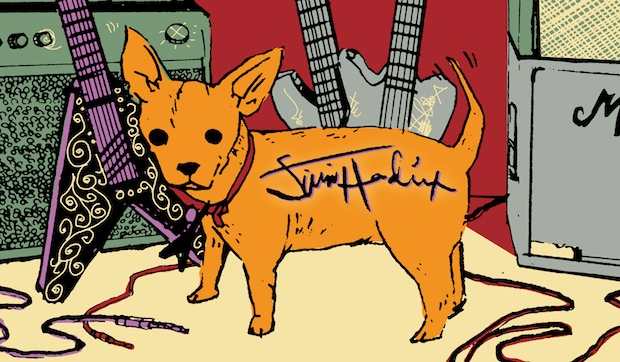
“There was a lady in the crowd with a chihuahua, and she hands the dog to Jimi Hendrix. He has these huge hands. Michelangelo would have loved to carve these hands out of marble. They were just superb hands. This little chihuahua became totally submissive and went to a totally new level of chihuahua consciousness. The dog just laid there with his head down on Jimi Hendrix’s fingertips. With his other hand, Jimi took a Marks-a-Lot and wrote on the side of the animal, ‘Jimi Hendrix.’
“He gives the dog back to the lady and the little dog pops up, the little bug eyes are looking around wondering, ‘What the hell is going on? What happened? What was that?’ It was one of the most amazing things I’ve ever seen, and I’ve seen a lot of shit. It wasn’t a Las Vegas act with animals that have been working with their trainers for years. It was a random chihuahua into Jimi Hendrix’s hands.
“It was one thing watching Hendrix when he was performing but this chihuahua thing was fucking mystical,” says Collins.
Steve Staples [now the owner of International Vintage Guitars] was the guitarist in the Gaunga Dyns, and he was totally enamored with the thought of seeing Hendrix in concert at Tad Gormley Stadium. By that time, the band had already put out its first album, which generated several hit singles and plenty of airplay in New Orleans. By the tender age of 17, Staples and the Gaunga Dyns had been on TV, played on Bourbon Street and at high schools, colleges and frats all over the South.
Jimi Hendrix was staying at the Hotel Monteleone in the French Quarter, where Staples and a couple of his friends went to try to meet the legend. He dropped his friends off in front of the hotel, and while he was looking for a parking spot, they found Hendrix in the lobby. He invited Staples’ friends up to his room, where he was entertaining friends and record company executives.
Unfortunately, Staples missed the party. “I didn’t know my friends had taken off with Hendrix, and when I came around I couldn’t find them,” he says. “They told me Hendrix was very soft-spoken, very nice and a real down-to-earth guy.”
Although he barely missed Hendrix that afternoon, his brush with greatness would come soon enough. He had a connection with WNOE DJs Tom and Paul Collins, known as the Collins Twins. One of the Collins Twins was dating the sister of the manager of the Gaunga Dyns and brought Hendrix over to the manager’s house in the Aurora section of Algiers for a visit.
It was the home of Minit Label’s Joe Banashak, who produced Aaron Neville’s “Tell It Like It Is” in 1967. Joe’s son, Jeff Banashak, was managing the Gaunga Dyns, and he drove Hendrix’s Cadillac to the Memorial Auditorium that day. It’s because of these connections that Staples and the rest of the band got tickets right in the center of the front row. They were only 20-25 yards away from Hendrix as the concert started.
The Soft Machine, a British psychedelic garage band, opened for Hendrix that night. “They were a fabulous sort of rock and jazz band,” Staples says. “They had an incredible keyboard player and a great drummer and a fantastic singer.
“And then came Hendrix. I think he had four Marshall stacks, and Mitch Mitchell had a huge drum set. There was a wall of nine or 10 amplifiers across the back of the stage. Hendrix played mostly Strat. He played ‘Red House’ on a black Les Paul, left-handed obviously. I’m sure it was one of his best performances ever.”
Hendrix did all his famed moves that night in New Orleans: guitar behind the head, behind the shoulder, playing the guitar with his teeth, making love to the guitar. And then, in front of that packed crowd in City Park, Staples saw Hendrix do something he had never seen him do before. “He took the guitar and pulled it around on his side like he was holding it under his arm and he pulled it away, shoved it forward, and then let go of it on the strap. The guitar literally left his hands and went up in the air, and he caught it and kept playing.
“‘Purple Haze’ was really good,” says Staples, “but ‘Red House’ was amazing to me that night. He just tore it up. I was not stoned or drunk; I was 17 years old and it was like being on drugs. It was so good. The other guitar player [from the Gaunga Dyns] and I sat next to each other and our mouths literally were open from the minute he started playing and until he went off the stage. We just turned around and looked at each other and went ‘fuck!’ It was so good.”
Bunny Matthews was still a student at UNO when he got the news of Jimi’s death, just a little more than two years after Hendrix’s show in City Park. Matthews concluded in his college newspaper column, “Sometimes he probably just longed for the days when he was just Maurice James with processed hair, playing rhythm in sweaty little black night-clubs. But it was too late. Jimi Hendrix was our idol. Like it or not. He was.”