DeLuna Fest

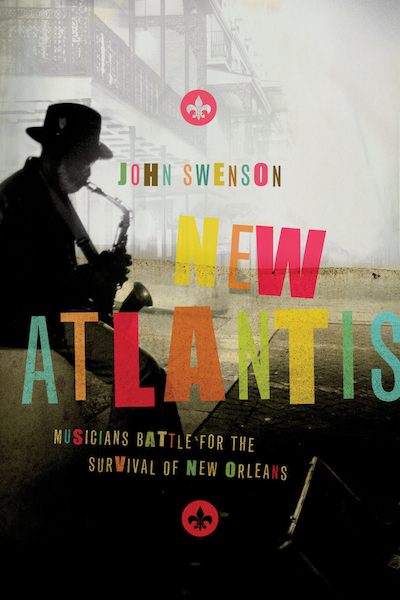
Excerpt from New Atlantis by John Swenson: Breaking the Silence

John Swenson, New Atlantis: Musicians Battle for the Survival of New Orleans (Oxford University Press)

This month, Consulting Editor John Swenson’s new book New Atlantis: Musicians Battle for the Survival of New Orleans examines the role musicians played in the city’s recovery. In this excerpt, he writes about the violence of 2006 and how it gave two musicians new artistic purpose.


Glen David Andrews says he was one of the last people to see his friend Dinerral Shavers alive. “I talked to him five minutes before he was killed,” said Andrews. “He said, ‘I’m working on my house over in the Musicians’ Village. When are you coming to help me?’ I told him I’d be there Saturday. I got a gig that day, and I’ma come a little early. He pulled off, drove three blocks, and the next thing I saw was his car running into a pole.”

“Dinerral was my first drummer in my own band,” Andrews said. “When Dinerral was killed, it was so bad because it was just getting to the point where it seemed like musicians was being slaughtered. Dinerral wasn’t a drug addict. He wasn’t a bad person. He had never been to jail. He was a beautiful, honest, young black male trying to make things happen.”

Andrews had been part of a music-education program at Sound Café, and the coffeehouse owner, Baty Landis, asked Andrews to participate in a march on City Hall to protest Shavers’ killing and the culture of street violence that caused it. However, even as a formal protest of the murderous atmosphere that resulted in Shavers’ death was coalescing, the killings continued. On January 4, 2007, one week later, another regular Sound Café patron, filmmaker Helen Hill, was killed. Hill was in the backyard of her home on North Rampart Street at 5:30 a.m. feeding her pet pig, Rosie, when she was surprised by an intruder, who shot her in the neck. Hill’s murder was one of six in a 24-hour period.

Helen Gillet was a friend of both Shavers and Hill. She had taken care of Hill’s pig when her family was out of town and had gone to numerous social events at her house. “I definitely knew her from my first year in New Orleans,” said Gillet:

“At one point I lived pretty close to where she lived. I was in charge of babysitting Rosie, their pig, when they were out of town. I remember Helen putting me through the ropes of how to feed her. I had a fear of pigs, so I was sort of afraid of the whole ordeal, but Helen was so great, her personality is really upbeat—very creative and reassuring at the same time. She was one of the women who really inspired me to do a lot artistic-wise.”

Gillet will never forget the day she found out about Hill’s death:

“I was at the Sound Café, [and] my brother was in town for the holidays because it was right after New Year’s Day. Somebody said, ‘Did you hear about that terrible shooting on Rampart Street?’ which unfortunately was not an unusual enough thing for me to jump up right away. Then I heard somebody else say, ‘It’s so sad. She had a baby,’ and then somebody said the word ‘Helen,’ and I thought, ‘There aren’t too many Helens.’ It’s an old-school name. I had to ask, ‘Who’s the father?’ and the father’s named Paul. I couldn’t believe what I was hearing. It was like your whole world has crumbled.”

Instead of falling apart with grief, Gillet was seized with a passion to do something about these tragedies. “I just became somebody else,” she said:

“I felt a lot of anger. I also felt a sense of urgency because so much had to be taken care of after the storm. You could become obsessed about copper plumbing; you could expend all your energy on one aspect of what the city needed and go there for years.

For me it was safety. They say you don’t kick into high gear until somebody you know is affected. I would be a hypocrite to say that that wasn’t true.”

Gillet joined Baty Landis and writer Ken Foster to form a group called Silence Is Violence, based out of the Sound Café, and organized a march on City Hall. “A lot of us got together,” Gillet recalled:

“Baty is an amazing part of this. She organized this march, and I MC’ed the event. As the performer of the bunch I was able to envision what the flow of the speakers at city hall was gonna go like. I got to know Glen David Andrews and the Hot 8 a lot more through that event.

The closest thing I’d ever done to political involvement was before I moved here. I worked with the Wisconsin Alliance for Arts Education, lobbying and stuff like that. Coming from playing music full-time and being involved in politics for three months, it was super stressful for me. We shared all the duties, but I took a fair amount of TV and radio interviews.”

The Sound Café’s protest mushroomed into a mass march on City Hall on January 11, 2007, where 5,000 people chanted demands for the ouster of Mayor Nagin and the district attorney, Eddie Jordan. The Hot 8 Brass Band led the march under a banner that read “March for Survival, Walk with Us.” Glen David Andrews marched alongside with a determined gait. Others held placards emblazoned with the slogan of the march: “Silence Is Violence.” Some held posters lamenting the deaths of Shavers and Hill. One sign had a picture of a child with the slogan: “Born in New Orleans…Murdered in N.O.”

“That march, it was just unbelievable working with and meeting all these beautiful people,” said Gillet:

“It really helped me to meet all these active and amazing minds that were way more experienced in politics. I was just maybe a little bit of a facilitator and MC and somebody to take in all this energy. People were looking toward me all of a sudden, and I had to keep reminding myself that you don’t have all the answers.

We had three starting points, one from Mid-City, one from Central City, and then the Ninth Ward contingent. We all came from different spots, and by the time we got to City Hall it was clear that there were thousands and thousands of people that came out. People were coming out onto the street out of the workplace, and you had the sense that the whole city was involved.

The most remarkable thing about the crowd was that it included people of all colors. In a city with a long history of racial polarization, the crowd composition recalled the makeup of the interracial protest marches at the height of the 1960s’ civil rights movement.”

Gillet’s crucial moment arrived when the crowd gathered in front of the City Hall steps and spilled across the street into the park. The podium was only about a foot off the ground, and Gillet was surrounded by people pushing and yelling at her, demanding to address the crowd. Mayor Nagin was only a few feet away from Gillet, and though his aides demanded a forum, he was never allowed to speak. “I had Mayor Nagin’s people poking me to get up on that podium,” Gillet recalled. “I had to politely keep saying no to all these people who wanted to speak because we had a roster of speakers, and it was my job to make sure they got to speak.”

Clad in a black sweater with a giant red paper heart pinned to her chest, Gillet determinedly kept the speakers to a predetermined program of appearances, summoning up a strength she didn’t realize she possessed before that moment. “I wore a heart,” she explained. “Helen liked to do these little animations, and she would cut out hearts, little hearts, so I cut out a red heart, and I pinned it on my chest to remind me of my humanity. I don’t know if this is a normal thing. When you’re dealing with politicians, you tend to think, ‘Oh, my god, am I still human?’ At this point I was just so freaked.”

Speaker after speaker railed against the violence that was tearing New Orleans apart and the lack of effective response from city officials. “We have come to declare that a city that could not be drowned in the waters of a storm will not be drowned in the blood of its citizens,” bellowed the Rev. John Raphael, Jr., reflecting the sentiment of the crowd but also avoiding the overriding issue that those citizens were killing each other.

It took a musician to speak the naked truth. “Young people, shame on you,” Glen David Andrews charged, aiming his anger at the killers and the endless cycle of violence they created. “You know better!” Andrews’ speech was an act of courage and leadership, but most of all it was a sign that the violence in his city had spurred him to rethink his own choices in life. Before the storm he had been thick with the bad-boy crowd and had written “Knock with Me, Rock with Me,” which coined the popular drug deal chant “Gimme a dime…I only got eight.” He had been an integral part of the ongoing cross-pollination of the city’s brass-band and second-line rhythms with hip-hop MCs, who borrowed freely from those genres. Nonetheless, in the wake of the flood, Glen David Andrews struggled to recast those musical values in a more positive way, his personal tribute to what he understood was a precious gift from his ancestors.

Andrews did not spare the other targets of his ire. He spoke eloquently about his fear of a police force whose members routinely harassed black musicians. He expressed particular anger at the mayor. “Mayor Nagin,” he shouted, close enough to Nagin for him to take it personally, “Get on your job!”

When I interviewed her years later, Gillet looked back on the day of the rally with wonder and realizes that those events at the beginning of 2007 became a turning point in her life and her direction as a musician. It was the kind of transformation that a lot of people in New Orleans were undergoing at the same time.

“I was on this adrenalin rush,” she said:

“I hadn’t cried since I heard the news about Helen. It had been a week. We pulled all of this together in a week. Baty and Ken are geniuses, but they knew I was much better at crowd management, and they were nervous about that part of it. I don’t think it was until after the speaking was done and we had our moment of silence that I was able to relax.

I was in a daze, walking by myself back to my car, and my friend Ben Schenck came and gave me a hug, and I remember just losing it at that point. I cried and cried and cried in his arms. I let it all out. I was finally able to begin my own individual mourning process, and it was three months later when I finally realized I had to let go of this. I had to go back to concentrating on my music. I wasn’t sleeping very much. I became this impossibly obsessed person. I definitely wasn’t taking care of myself. I gave it my all while I was in there, but I realized I have to be a musician, and I have to focus in on that. I was just talking to a couple of improvisers about this, and I think it did influence my music quite a bit, this whole period.”

From New Atlantis: Musicians Battle for the Survival of New Orleans by John Swenson © John Swenson, 2011, Oxford University Press. Reprinted with the permission of the author, all rights reserved.


blog comments powered by Disqus
Jazz and Heritage Foundation presents Patti Austin in Concert