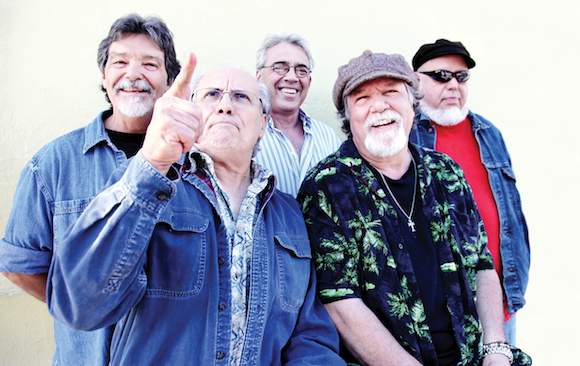
Thirty-three years is a long, long time, just about half of most people’s lives. Long enough to be an era. In this case, we’re talking about the era of the Radiators, a band that defined its time and place in New Orleans history and will play its final series of shows June 9 through 11 at Tipitina’s. Though the Radiators have been compared to a lot of other bands, they’re a unique phenomenon that is only possible in the cultural landscape of New Orleans. The band’s eccentricity is even more pronounced in its proposed afterlife. The group is not disbanding because of the death or incapacitation of any of its members, nor is it breaking up for musical or other irreconcilable differences. The five Radiators—keyboardist Ed Volker, guitarists Dave Malone and Camile Baudoin, bassist Reggie Scanlan and drummer Frank Bua—remain close friends. The band is in fact retiring at the top of its game, with a victory lap at Jazz Fest and three final shows at Tipitina’s interspersed with command performances in fan strongholds across the country—South Florida, San Francisco, Memphis, Minneapolis and all over the East Coast.
Volker announced his decision to hang up his rock ’n’ roll shoes late last year, explaining that he was visited by a series of dreams that left him with the feeling that the time had come to call it quits. Volker, whose numinous visions have animated the band’s songs and coined its “fish-head music” mythology, has always been guided by the unconscious muse, and her vision of total evaporation was a siren call.
Who could have guessed that it would also be an apt career move? Radiators fans suddenly went viral. Tickets for the final shows at Tipitina’s sold out in minutes. Shows across the country followed suit, and suddenly Radiators tickets were harder to get than at any time in the band’s history. In addition to its annual performance at the M.O.M.’s ball the Saturday before Mardi Gras, the group was asked to play at Carnival balls for the Krewe du Vieux and Orpheus. Tickets for a four-night stand at the Great American Music Hall in San Francisco were gobbled up immediately. The band’s Jazz Fest schedule is busier than it’s been in years—seven shows capped off by its final Jazz Fest performance closing out the Gentilly Stage May 8.

Ed Volker performing with the Radiators at the Guthrie Theater in Minneapolis, 1991. Photo by David Rae Morris.
Everywhere I go in New Orleans these days, people are talking about the Radiators. A guy standing at the bar at the Apple Barrel railed at their decision to quit. “They can’t do this!” he declared. “Too many people depend on them.” Radiators-themed costumes proliferated at the M.O.M.’s ball. One guy wore a winged pig suit with a placard reading: “Rads Goodbye? When Pigs Fly!”
One night, friends and I sat down for dinner at Charlie’s Steak House, but before we could tell the waiter what size steak we wanted, he pointed to my friend Brendan and asked, “Are you a fun-gi?” He was referencing a magic mushroom T-shirt Brendan always wears to see the Radiators at Jazz Fest.
“I’m there every year for the Radiators,” said the waiter. “Right down in front of the stage. I’m the guy who used to bring the wading pool and set it up down there. I always made a lot of friends on those hot days. Eventually, the Jazz Fest people made me stop doing it.”
I was surprised that he recognized Brendan, but there’s an almost tribal relationship among Radiators fans. I’m one of those fans myself, and I’ve made a lot of friendships over the years at Radiators shows, people I never see anywhere else but are always smiling hello when I run into them at Tip’s or the Maple Leaf or Lafayette Square. The fans are organized in various cities around the country that have their own krewes, like the Krewe of Dads in Minnesota and the Monkey Krewe in Florida. Volker has written songs suited to the themes of the parties thrown by these krewes.
When I first saw the Rads at Tramps in New York City in 1984, the fans were already a kind of secret society. The band sold out the gig with no promotion or radio presence, just the avid participation of tape traders and former Tulane students living in New York who wanted the connection to New Orleans the Radiators represented. The mostly original music that ran the gamut from early rock ’n’ roll, blues and country to New Orleans R&B and funk left me wanting more, and I soon connected with the fans whose tape trading trees were spreading the news.
“That’s really how we started to get gigs on the East Coast back in the old days,” says Scanlan. “People would come in and ask if they could tape shows. We said ‘Sure, if you want to go to the trouble to tape the show, you can have it.’ We didn’t realize that the tape traders were sending these things back up to the East Coast. When we went up there to play, people already knew who we were. It was an amazing grass roots advertising system.
“I remember one of the first gigs out east, I think it was in North Carolina, we started playing and people were yelling out the names of the songs—our songs. It was astonishing. I wanted to make it interesting for me and for the other members of the band, but the audience picked up on it. We would mix it up going from a Muddy Waters song to a Meters-type of song to a Merle Haggard song as well as the whole New Orleans canon. We were firmly grounded in the eclecticism of the 1960s.”
The band signed to Epic Records and made three nationally distributed albums before asking out of the contract and returning to its independent roots, an extraordinary decision that brought the group even closer to its hardcore fans. Volker explains that the band was never trying to expand its base to arenas and follow in the footsteps of the Grateful Dead. “I think our close connection to the audience has something to do with the fact that we didn’t reach the stature that the Dead had in their last 15 years,” he says. “We didn’t play in arenas. We have always been able to maintain some kind of alchemy between the band and the crowd. I think when you play arenas, you can’t sustain that. I remember I used to take three dollars with me to see the Meters. It was a dollar to get into the club and I would have two dollars for a couple of beers. It was such an amazing thing being able to watch the Meters in their heyday in the ’70s play all night long in a small club. Then I saw them in Baton Rouge opening for the Rolling Stones and I didn’t get the same thing out of it at all. I don’t think that music really works in big spaces.”
So the band has continued on over the years, playing to the faithful, fans that pay attention to every detail of an astonishingly varied book of songs. One night the group could seem like the best bar band in history; the next night could turn into an extended modal jam session, an exercise in songwriting deconstruction or a moody, poetic night of introspection. The character of the audience often determined the direction of the performance.
“We were very privileged to be graced with such an audience,” Volker muses. “We hit some kind of nerve with people. I don’t know how to articulate what that could be. I’m inside of it so I don’t have a perspective on it. Really, that’s what’s kept us alive.”
And now it’s almost over.
When Volker announced his decision to quit the road, the news came so suddenly to some of the band members they thought he was joking.
“When we had the band meeting at the hotel room in Chicago,” recalls Bua, “I walked in and said to Ed: You’re kidding, right?”
“No,” says Volker. “I’m serious.”
Bua knew Volker meant it when he saw the look on his face, a look he remembered from a lifetime ago when he was in another band with Volker, the Rhapsodizers.
“I’ve seen that look once before when we were in the Rhapsodizers,” says Bua. “It was me and Camile, Becky Kury and Clark Vreeland. Ed wrote all the songs. Ahmet Ertegun at Atlantic Records had seen us at Jazz Fest and wanted to sign us to a recording contract. I think this was ‘76. They brought Ed and Becky up to New York and it looked like everything was set to roll from there, but Becky became the focal point and it upset the chemistry of the whole thing. Atlantic decided to throw Becky into the studio with a studio band. Ed asked Becky what she was going to do and she said ‘I’m going to take the best offer.’ Ed quit right on the spot. I was there. I saw that look on his face and it was the same finale. Something had come to an end.”
The band members’ reactions ran the gamut of emotions, from a near sense of relief from Scanlan, who said he’d been expecting it, to denial from Malone and a painful confusion on Bua’s part. “For me, it’s like when you’re younger and you think things never change and your parents will never die,” Bua says. “It’s like that. In my mind, it was never going to die. I thought about it, but I never could really wrap my mind around it. I was devastated. I went home and walked around the house, crying like a little child. I felt like someone took my favorite toy away. I went from being totally depressed, to disbelieving, to being really angry.”
Baudoin admitted to being in a state of shock, and found solace in a chance meeting with an old high school friend, Zigaboo Modeliste.
“It’s all serendipity,” says Baudoin. “I dropped my car off at a place under the bridge to get a brake job, under the Crescent City Connection, and I know of a little breakfast place about three blocks from there. I’m sitting there eating breakfast and in walks Ziggy and his wife Kathy. There they were at 7:30 in the morning at this little breakfast place completely out of the way. I was just like really shattered at that point, burned out and wondering what was going to happen, and it was nice to be able to talk to an old friend like that. Zig went through a similar thing with the Meters.”
As bad as the band members felt, the extended family of fans took it even harder. “I was dreading the reaction, because we mean so much to so many people,” says Volker.
“As we go on, the emotions get more and more intense,” adds Baudoin. “We’re feeling the death and rebirth at the same time. You see people being sad about the end, but feeling really great about the years. The last couple of nights I’ve run into half a dozen Tulane people at gigs from when we used to play the Quad. So many of our fans are family and close friends.”
“Guys are coming up to me after shows,” says Malone, “big, burly Hell’s Angels guys crying on my shoulder, begging us not to stop. Other people come up to me and say, ‘You can’t let this happen! Do something about it!’ Many people over the last couple of months have told me with tears in their eyes how all of their best friends and in many cases their spouses met because of the Radiators.”
Some of the first gigs after the announcement reflected the stunned reaction of both band members and fans, but as the shows went on, a spirit of elation took over.
“The Radiators have had their time, and it’s probably better to close it down now with a little bit of style than to just kind of fall apart,” says Scanlan. “I have to say that I think the band is playing at more of the level that it was at 15 years ago. We only have so many gigs left to go, so it’s almost like an unspoken thing that every gig has to count. Everybody is playing up to the mark, and I can feel some people in the band getting a little more sentimental. When you’ve got guys backstage crying and saying that this is worse than when they got divorced, I go ‘Whoa, it’s just a band,’ y’know?”
But it’s not just a band to those people.
“When that started happening, it dawned on me that the real thing the band achieved was not that it played great music and Ed wrote a lot of great songs,” says Scanlan. “A lot of bands do that. But our crowning achievement is that we were the catalyst for the formation of an amazing community of people. People talk to each other across the country. They travel to meet each other. They met their wives at a Radiators gig. We’ve become part of the tapestry of a lot of people’s lives. I think that’s
really what we did. We proved that music really does bring people together.”
The individual members of the Radiators have had time to think about what they’re going to do next. Scanlan has been working with drummer Willie Green of the Neville Brothers. Their band, the Usual Suspects, is prepared to hit the ground running in June. Scanlan is also the bassist in the Mardi Gras Indian Orchestra. As of this past Fat Tuesday, Baudoin is the lead guitarist in the Orchestra, which also includes singer/storyteller Sunpie Barnes, drummer Kevin O’Day, saxophonist Tim Green, cellist Helen Gillet and violinist Harry Hardin. This outstanding group has put some new interpretations and embellishments on the arrangements of Mardi Gras Indian chants and story songs first explored by Willie Tee and the Gaturs and the Neville Brothers. Baudoin and Scanlan lay down a compelling trance rhythm in this setting that rivals their most exciting playing with the Rads.
Baudoin, who has known Volker since kindergarten, is completing work on his first solo album, a tribute to his Cajun country roots. “Ed is a dear friend and the person I’ve known longest on this earth,” says Baudoin. “But doors open and doors close, and I’m looking forward to being challenged creatively. I’m doing a CD from my early days about my godfather who taught me guitar when I was growing up. I figure it’s a good place to start. Like the band, I’m very eclectic. Playing with the Radiators, you can’t help but be because you’ve got to go everywhere musically. It’s just two guitars and a violin. I’m singing some simple country and western songs, playing with David Doucet from BeauSoleil and Harry Hardin, the violin player with Johnny Sketch and the Dirty Notes. I’d like to put together some CDs going through the different musical stages of my life. All kinds of things are going through my head. We used to be Earl King’s backup band. I thought about doing a record Songs in the Key of Earl.”
Malone has been entertaining several post-Radiators projects, including a reunion of Monkey Ranch, a band that also included Scanlan and Willie Green; a vocal harmony group with his kids called the Chilluns; and a rock band with his younger brother Tommy Malone of the subdudes, the Malone Sharks. “I’m tossing ideas around,” he says. “A specific plan is to come up with a specific plan. I’ve got a lot more time, and I don’t intend to do anything right away.”
Volker has fine-tuned his own semi-retirement plans: “I’m not going to step on a plane or a stage for six months. When 2012 comes along, I’ll think about what I’m doing next. Meanwhile I’ve been involved in an archival project that I’ll keep working on.”
Outside of Volker, the Radiators’ retirement is not set in stone for the remaining four members. Malone, whose front stage presence as the Radiators guitarist/vocalist makes him the band’s most charismatic figure, still thinks of himself in those terms and will probably carry the image of the Radiators with him no matter what he does. Bua will not accept that his future does not include playing with some version of the Radiators. Baudoin and Scanlan are willing to keep going without Volker, who has encouraged the rest of them to move on without him. In fact, the band has already practiced with a new keyboardist who would almost certainly join any new configuration.
“The Radiators are whatever we want to call it, but the band would have to have either Ed or Dave to go on because they sing the songs and are the front men,” points out Scanlan.
“If I do something with the other three Rads and whatever other musicians we involve,” adds Malone, “it would be some other version of the Radiators, Part Two, like on the old 45s that had Part One on one side and Part Two on the other. We’d have to bill it as Radiators Part Two, but we wouldn’t do it to the degree that we do now because I want to leave my options open.”
But any new lineup without Volker will be missing an essential ingredient in what has made the Radiators so special over the course of their era.
“As these last shows approach,” says Volker, “what I’m hoping is that something akin to magic happens between the band members and the audience. But you can’t activate a dream. It just happens.”