DeLuna Fest

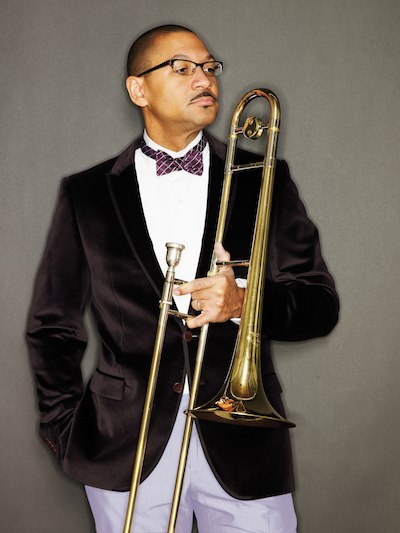
Delfeayo Marsalis

Delfeayo Marsalis Backtalk Interview

In 1957, the Duke Ellington Orchestra recorded Such Sweet Thunder, a suite of 12 compositions based on the writings of William Shakespeare. It was remarkable program music designed to explore the personalities of Shakespearian characters including Lady Macbeth, Othello, Romeo and Juliet, Hamlet and Henry V. Some of the pieces were even composed in sonnet form. Delfeayo Marsalis has been fascinated to the point of obsession with this project for many years. He wrote his thesis on the suite and studied Ellington’s original scores in detail. Marsalis recently recorded his interpretation of the album, Sweet Thunder, which takes calculated liberties with the original. The album will be released later this month to coincide with a theatrical tour in which an octet featuring Marsalis will accompany the actor Kenneth Brown Jr. in a music and words program dedicated to the Duke and “Shak,” as Marsalis refers to the Bard of Avon.

Marsalis will perform at the Jazz Educators Network Conference January 8 from 7:30-9 p.m. at the Roosevelt Hotel’s Ballroom. He’ll launch the Sweet Thunder tour January 19 and 20 at the Mahalia Jackson Theater.

This has been years in the making.

Our first major concert of this material was in Minnesota in ‘07. That was important because for example the solo section of “Madness in Great Ones” came out of the understanding that we need to develop this material more. Also, Branford’s solos on “Half the Fun” and “Sonnet for Caesar,” we were able to develop that material a little more.

One thing you notice right away is that you’ve switched the running order of the pieces from the original suite, although you start and end just as Ellington did with “Such Sweet Thunder” and “Circle of Fourths.”

Because the music develops in such an extremely different way from the original, there were two streams of thought. On the one hand, you have what we consider the old school, kind of a swing sound, from that to a more modern sound. We wanted it to cover as many styles as possible. “The Telecasters” is a prime example; that’s based on a dance routine, an old soft shoe number. We wanted to include as many different styles as possible, but also juxtapose one right next to the other. “Half the Fun” is a modern kind of funk sound, and then after that is “Up and Down,” kind of a be-bop swing feel. You realize how closely related all the music is. His music incorporates so much information. The great thing about Sweet Thunder from my vantage point was that it was not as developed. Most Ellington music is so fully realized it’s hard to jump in and say, “We’re going to change this up.”

Most of the original tracks are very short. “Hank Cinq” is only 1:24.

That’s a perfect example of why we had to change the order. Our musical performances kind of dictated the song order. After we listened back to our studio recordings, which were a lot different from the live recordings, the studio recordings dictated what the order should be. I had a pretty solid idea emotionally of where it should go because the recording is designed to take the listener emotionally to different places. For example, Ellington’s second piece was “Sonnet for Caesar,” but there’s no way “Sonnet for Caesar” could be second the way we played it. It was so emotionally intense we had to save that for the end.

Your version is much more elaborate, more than twice as long, and the solos are very dramatic.

I’m heavily influenced by operatic music. I don’t see why jazz musicians can’t use those elements. On “Sonnet for Caesar,” Branford incorporated some Egyptian music into his solo. I told him Caesar was a great man. Establish his greatness for us. Why did the people actually love him? Then as you’re developing that, all of a sudden there’s a twist of fate. To me, that’s the great thing about jazz, that a player is able to express such complicated emotions. It’s not just “Here’s a set of chord changes.” Let’s see what you can play.

How closely did you follow the original score when you sat down to orchestrate your version?

I not only followed the original score, Ellington’s recording is different from the scores he left at the Smithsonian. When he got to the studio, he made certain alterations to his sheet music. He would just tell Clark Terry, “Change that A-flat to an A.” We stuck to the original score so there are some notes that are intentionally different from the Ellington version on my recording. One example is the melody to the bridge to “Hank Cinq.” There’s a one note difference. He put a flat five in there. Instead of using it both times, we just put it in the second time.

In “Half the Fun,” the rhythm track has more elaborate African percussion, using the bells and almost heading in a Sun Ra direction.

Sun Ra was always a favorite of mine. I played with one of his lead trumpeters, Michael Ray. I was sorry when he moved away. One time we did this suite with a big band and Mike played the lead. We had him play the “Madness in Great Ones” solo. I always try to employ different genres and different players. My personal preference is not to have guys who all play one way. I’m always looking for the perfect foil. For example on “Madness…,” Victor Goines is playing the lead on sopranino sax. He’s going crazy. I’m trying to convince him not to go crazy. The way that I solo is perfect for that because I’m just being really logical.

The tradition is what keeps it focused. Johnny Hodges could have been on the bandstand with John Coltrane and Ornette Coleman and they could have made music together because back then, even the avant-garde musicians had the same influences. They were playing avant-garde, but they were listening to Duke Ellington. I like to see young musicians not just study harmony and try to advance the music, but also to bring the dance element back.

Ellington wrote some of the original pieces in sonnet form and you’ve changed some of these but not others. On “Sonnet for Sister Kate,” your version is almost the exact same length as Ellington’s yet on “Sonnet in Search of a Moor,” yours is four times the length. Similarly, “Hank Cinq” is much longer in your version.

“Hank Cinq” is a blues. A sonnet is iambic pentameter, which is 10 syllables, so we would play a 10-bar blues. The form of the song dictated the solo sections. The form of “Sister Kate” did not really allow for a solo, so it was more natural to have a solo for “Hank Cinq” and also for “Sonnet for Caesar.” The way the melody developed, it made more sense to have solos, where “Sister Kate” was perfect as it was composed, although we altered the introduction. Ellington’s introduction is shorter. We also gave it to the bass clarinet, so we changed it up in that sense as well. I tried to be both truthful and irreverent to the original at the same time. On “Sister Kate,” we put a drum groove underneath which compelled me to play the melody differently.

Ellington used a similar design for all the sonnets. You either have the clarinet playing the melody with the trombones supporting, or you have the trombone playing the melody with the reeds supporting. We had the trumpet function more like a reed instrument. Duke Ellington didn’t use trumpet in any of the sonnets because trumpets typically play less of a supportive role.

Ellington used his soloists to portray different characters in Sweet Thunder. How did you deal with that when you put your soloists into those spots?

It would not have made sense to recreate the suite. Part of the notes is a letter from Gunther Schuller. His take is that Ellington music should not be recreated. If I had gotten a big band to recreate what Ellington did, it would not make much sense. In that respect, I agree with him. I do think this material lends itself to interpretation. I almost had a trumpeter play “Madness in Great Ones,” but there’s nothing you can do beyond what Cat Anderson played on that.

“Up and Down” is also almost the same length as the original.

That was composed by Billy Strayhorn. Strayhorn composed front to back much more than Ellington did. Strayhorn’s concept for composition was to have a complete package all the time, but Ellington always left room for interpretation. “Up and Down” was meticulously composed by Strayhorn. It was difficult to add anything, so we just left it alone.

Are you playing this material slightly faster?

I think we’re playing a little quicker, this being a faster and a louder generation.

“Up and Down” is three seconds longer on the original.

Some musicians want to make an exact recreation, but that’s not me. When I played with Elvin Jones, people would want it to sound like a Coltrane recreation band. He just said, “I already played with Coltrane.”

Your reinterpretation ends on quite a dramatic note with “Circle of Fourths.”

The song was on the heels of the famous Newport “Diminuendo and Crescendo in Blue” solo that Paul Gonsalves played, and I think Ellington was trying to maybe do something similar, but he ran out of time. He kind of threw it together, and he didn’t have the time for it to really have the kind of impact that he actually wanted. So on that and “Star Crossed Lovers,” we discarded the Ellington arrangement altogether. On the recording, he has the orchestra supporting the soloist, which I thought would interfere with what we had in mind. The other thing we do with “Star Crossed Lovers” is we change key for the alto solo. We start off in G and then we go to the key of B flat. That’s a large leap. That’s the original key of the song, but we start off a tri tone away.

blog comments powered by Disqus
Michael Arnone's Crawfish Fest, New Jersey