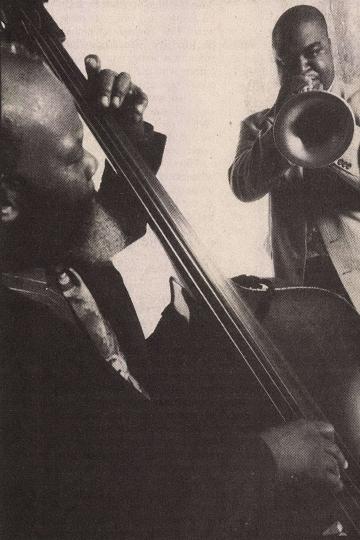
Both Walter Payton, a longtime New Orleans journeyman bassist, and his son Nicholas, a fast-rising trumpet powerhouse, were assigned to the tuba while in grade school bands.
In Walter’s case, “I was this little fat cat in the band—[the teacher] came in one day and said, ‘Here. You play this.’”
Years later, when Walter was Nicholas’ music teacher at McDonough 15 Elementary School, he assigned his son to the tuba as well. “I needed a tuba player, so I said, ‘Nick, play the tuba for me,’” he laughs.
They have both left the tuba behind. Now Walter plays an upright bass crafted by a Czech artisan named Juzek more than a century ago. Nicholas’ instrument of choice is a weighty, 24-carat-gold embossed trumpet given to him by David Monette, the man who makes the horns used by Wynton Marsalis, Nicholas’ mentor.
Walter, 52, is often perceived as the good-humored Big Easy musician, capable of and willing to play a variety of styles, whatever the gig calls for. Nicholas, who turned 20 in September, is seen as a serious-minded neo-traditionalist, dedicated to the furtherance of the Art of Jazz.
There is some truth in these perceptions, but only some, for the Paytons do not fit easily into any assigned categories.
Their relationship is based on mutual respect. Walter granted Nicholas this respect at an early age, and Nicholas rewarded it with a highly developed sense of responsibility, one that gave Walter no qualms about allowing his son to go on the road unsupervised when his was 15. Nicholas did not betray that trust.
Walter attended his first jazz concert in high school. He attended Xavier University, and started doing session work while still in college.
His sessions included those for Aaron Neville’s “Tell It Like It Is.” “I dug jazz back then, but I made most of my money playing rock. Now I dig rock, but I make most of my money playing jazz.”
Walter is now in his third year of retirement from teaching, and he has made the most of it. In the last couple of years, he’s contributed to all three of what turned out to be Champion Jack Dupree’s last albums, as well as Kermit Ruffins’ solo debut World on a String and Chuck Carbo’s comeback Drawers Trouble. And he is working to establish his own combo, Snapbean.
Nicholas is currently the musical director for former John Coltrane drummer Elvin Jones’ band. In that capacity, he recruited fellow New Orleanians Greg Tardy and Kent Jordan for Jones’ group. He also performs with pianist Marcus Roberts occasionally.
He is in the final stages of negotiating a major label recording contract, and hopes to lay down his debut album later this month. He currently lives with his mother (she and Walter divorced several years ago), brother and sister, but plans to relocate to New York later this year, to be closer to the action.
Walter appears with Snapbean the first three Mondays of October at Snug Harbor; Nicholas will be with Elvin Jones at the Woody Herman Room of the Hyatt on October 16.
The father and son sat down in Walter’s living room one afternoon to discuss their lives in jazz.
Walter “learned everything the hard way.” He was raised by his grandmother and great-grandmother, who were not musicians. “As a musician growing up, people were patient and tolerant [with me]. That’s a debt I owe.”
His mentors included Edward Frank, Ellis Marsalis, Curtis Mitchell. He would call them on the phone for instruction.
As one might suspect, the environment that came with having a professional musician for a father played a large role in Nicholas’ development. “I grew up in a musical environment. I remember being around at rehearsals, moving around different musicians’ instruments. I guess when I was about four or so I asked my dad for a trumpet. He gave me one for Christmas. He bought me a pocket trumpet, which is wrapped around, more compact.”
Why did he ask for a trumpet?
“I don’t really know. I guess I always associated the trumpet with the lead instrument whenever I’d see bands. And I just had a fascination with the instrument and its power.”
When he settled on trumpet, was his bassist father disappointed?
“No, no, not necessarily. I don’t know how the trumpet came about. But like he said, at home there was music around all the time. When me and his mother were married, I had piano already. I was playing with different groups, and it was convenient to have a piano at home, because a lot of the stuff I was doing was classical. But then again, it was a good way for me to have rehearsals at my house, with the piano being there. All the bands I played with rehearsed at my house. Red Tyler, Ellis, whoever I was playing with at the time.”
Having Pop as a band instructor was not easy. “It was difficult, being that it’s hard to assess those roles of teacher and father. I’d get a lot of heat from the kids. There were several altercations with students who had some kind of problem with my father.
“Then again, I got into close relationships with my teachers, and they were more helpful to me, because they knew me from even before I went to school.”
They tried to down-play the situation. “When I was in the band, I was just another student. He didn’t single me out, which is good. Whatever I had was truly based on whatever ability I had at the time.”
Because the Paytons’ school was located in the French Quarter, Walter would often bring his charges to Jackson Square to play. They also played at Jazz Fest. Walter taught them popular standards, as well as jazz tunes.
Not all the experiences were positive. Nicholas grimaces at the memory of un-stylish blue ponchos he and his fellow musicians were made to wear. Both Paytons remember being heckled by spectators along the route of a Martin Luther King Day parade who did not appreciate the band’s repertoire.
“That was a lot of ignorance,” says Walter, shaking his head. “When we did the MLK Day parade, we would do things like ‘We Shall Overcome.’”
“But they didn’t want to hear that,” remembers Nicholas. “They wanted to hear whatever they hear on the radio when they go out to the clubs. In hindsight, I see that, but at the time, it was the worst thing in the world. When you’re a kid, you place everything on what people think of you, especially your peers.
“And then we had to say these funky [chants]…”
“Oh, oh yeah,” says Walter, owning up to that particular slight. “I had a little chant we used to say to march to with a drum cadence. I don’t remember where it came from. It was ‘na-na-neata-oh-oh.’ It came from my childhood somewhere, a song, or something we used jumping rope. I laid it on them—maybe they’ll find out where it comes from one day,” he laughs. Nicholas was not the most disciplined student. “I was always a student who never did as much as he could have. When I applied myself, I was a great student. But there were a lot of things that I didn’t feel were important. I was really into music. A lot of time, studying and doing homework, I would be a little lazy about.
“It wasn’t that I was against learning, but the approach that a lot of teachers had toward those things wasn’t as interesting as my father toward his music. If a lot of the teachers could understand and have a love of what they taught, that could come to the students.
“I always had a lot of conflict with my teachers, because I would question all the time. That was a big thing in my childhood, even at home. Teachers a lot of times would feel threatened, because they were afraid to say, ‘I don’t know.’”
“To add to what he said, music is very important to me, because it saved me,” continues Walter. “I tell people all the time, I could have been the black Al Capone if I didn’t learn how to play music. Most of my buddies, the ones that are still living, half of ‘em are locked up somewhere or got [criminal] records.
“We came up poor, man. We didn’t have anything, so if you didn’t get an education, and get a decent job, you went the other way. [Music] gave me a way to make an honest living, plus something constructive to do with my life.
“When I was teaching, I tried to impart that to my students as well. And I didn’t mind sharing whatever I had with them because I knew it could make a difference in their lives.”
So he was doubly happy when Nicholas chose music as his life’s work. It gave him less to worry about.
“I never had to worry about him. Before he got involved in music he was cool, and once he got involved in music he was doubly cool.
“I encouraged him to excel. I told him, ‘Well, you’ve got to do this and you’ve got to do this,’ but after a point, I just backed off and said, ‘It’s gonna be alright.’ I knew he didn’t do homework as much as maybe I would have liked. I knew when he did decide to, he could deal with it.”
“The music thing, at first when I was beginning, it was no stress,” says Nicholas. “When I started getting a little bit more ability, there was [an effort] to make me practice, and I complained and I rebelled because I didn’t want to do it. It’s something that’s hard for me even now. You have to have a tremendous amount of discipline to sit in a room alone with a book and read that music. It’s tedious, hard work. And it’s not a situation where you’re necessarily making music, you’re just working on specific things that you’re trying to correct, bad habits that you’re trying to correct.
“For that reason, I didn’t want to do it. He used to bribe me, ‘I’ll give you $2, just please practice for 30 minutes.’ After a while, he left me alone. He made it my decision if I wanted to practice. And I didn’t for a long time. And then later on, like a couple of years ago, I decided that I did.”
After Nicholas started working with the All-Star Brass Band in junior high school, “he never looked back. I didn’t have to tell him nothing. They were making more money a day than me sometimes.”
“It’s ironic,” chimes in Nicholas, “because sometimes I would play too much, and disturb him.”
Nicholas’ parents bought him his own stereo, since he spent so much time on the family’s system, playing tapes to practice with.
Nicholas got his first taste of the road in the company of his father in the Louisiana Repertory Jazz Ensemble, playing bebop and early New Orleans musicians—King Oliver, Jelly Roll Morton—at weekend showcases at colleges.
Nicholas first went on the road without his father at age 15, as a member of pianist Marcus Roberts’ ensemble. Walter says he had no reservations about this. “No problem. He was already pretty well centered. I trusted him.”
“Even at home…I guess they knew,” offers Nicholas. “There were certain things that they didn’t have to tell me, I just didn’t have an attraction. I remember I used to go on gigs when I was like 13 or 14, people would ask me if I wanted some water or punch. I wouldn’t even drink that. I was just scared, I wouldn’t want to be involved with alcohol. I just didn’t like all that kind of behavior that it causes.
“In the little brass bands, people would want me to smoke a joint. I used to get into fights because people couldn’t stand that I just didn’t want to do that. I’ll play with you, we’ll hang out, fine. But when you do that, you go that way and I’ll go mine.”
They never had any sort of father/son chat about dos and don’ts. “No, not at all,” says Walter. “He had been around me—anything, if he hadn’t asked me, he knew by example. I felt he had been brought up right, and if he went astray, it was because he wanted to. By that time, it was time for him to go out and experience. He could handle himself. He could from two or three or four years old. I think he was about three when he made his first trip. I was playing with the New Orleans Ragtime Orchestra and we went to Sweden on a six-week tour, and I took him.
“I remember once we had gone to a Jazz Fest boat ride [on the President], he might have been five. He had his little brother, and they wanted to go to the bathroom. I said, ‘Go ahead, take him.’ People were looking at me, but he could handle it. I knew he could go and come back. The crowd was packed, I didn’t know where the bathroom was, but he found it and found his way back to the seat. I knew he could handle himself.
“I never had to sit down and talk with him about any specific issues, but I knew when issues came up, if it was something that we got into it about, the way he would handle it, I knew he could handle himself, because if he could handle it with me, he could handle it with anybody, because I ain’t easy. He could hold his own. I had no problems with him going out on his own, because I knew he could stand up for what he believed.”
Wynton Marsalis recommended Nicholas to Marcus Roberts. Roberts called and asked Nicholas to play over the phone, then invited him down to Florida for rehearsals in preparation for a tour.
“By that time,” says Walter, his son “was handling his own business. He knew if he had a problem with something, he could come say, ‘Well, what do you think about this?’ But other than that, he was cool.
“He could see from things that I went through, because my life was an open book in the house. He could see how I handled things, and what to do and what to look out for.”
One time, Walter was fired from a band for no apparent reason. He surmised that it was something personal, as he had begun to voice his opinions on the way the band was run. “This started happening around ’87. Before then I was basically known as a nice cat. I started standing up for what I believed in. If something wasn’t right, I’d say it. And I don’t care who it was. Some people don’t like that, especially if you’re not the leader [of the band].”
His son is more apt to do that naturally. “I don’t want to go on the bandstand every night and have a messed up attitude, and they’ve got a messed up attitude, and the music is all messed up. Once it gets to a point where the music is not right and people are making things difficult…I like things to be very straightforward, and I like communicating with people directly. I don’t like people insinuating, or playing little games. I don’t like b.s. I don’t have good tolerance. If I see somebody is trying to use me, whatever way I can correct it immediately, that’s what I do. I don’t toy with people. If I have something to say, I say it.”
When asked to illuminate the origins of his mentor relationship with Wynton, Nicholas chuckles, for already he has “told this story a million times.
“I was really into his music, but I didn’t really know him personally. He called my house for my dad, so I got my horn and I purposely played so he could hear me in the background. He told my dad, ‘Bring him over.’ So I went to his house and we played together. He’s been instrumental in my development ever since.
“There’s been a lot of people who have been on my side.”
His old man says he never pulled strings for his boy. “The guys, Clyde and Kemp, who would rehearse by my house, they’d hear him, and quite naturally they’d tell somebody, ‘Yeah, man, the little cat can play.’ Word gets around. Even now, it hasn’t been me that’s been spreading the word. Once Wynton and Clarke Terry and these cats found out about him…
“And I think that’s more important than me blowing his horn, because, ‘Oh, yeah, that’s his son.’”
Nicholas, it seems, has patterned himself after Wynton and other so-called “neo-traditionalists,” who come across as extremely serious-minded in their approach.
“I don’t think it’s a thing now of musicians taking it seriously,” says Nicholas. “Musicians have taken it seriously from Louis Armstrong on. My dad practiced all the time—I could never practice like that, I don’t have the discipline. I love music, but just to sit there [and practice], that’s something I’m still trying to do.
“Musicians are being a lot more verbally expressive of the particular philosophy of the music that they embrace. Yes, there’s a lot more of that now. It’s not that Dizzy Gillespie and Louis Armstrong and all these musicians were not as intellectually advanced, a lot of them just didn’t express those things that they were doing, because obviously they knew what they were doing, otherwise they couldn’t play as great.
“How you dress and how you present yourself has a lot to do with how you feel about what you’re going to play.”
Many people find it interesting that the thoughtful young player is the offspring of the more happy-go-lucky Walter.
“Well, that’s the new me,” laughs Walter. “The old me—he’ll tell you—was never smiling. I was playing a job on Bourbon Street one time and a lady came up to me and said, ‘Why don’t you smile?’ ‘I’m not here to smile. I’m here to play the music.’ But then I started to think about it, and that’s transmitted to people. Even if the music is great, some people, if they don’t see you smiling or looking like you’re enjoying it, then they don’t get into it either.
“I used to be very serious. It came to a point where I used to not open my mouth or say anything about things. Now I do. Now I might laugh and joke. That’s a different me. And I’m starting to realize the importance to do that, for me.
“And it’s interesting to hear that people are picking that up now. I went way over to the right to get there. It was a big change. It was a change that had to come.”
“I don’t know…this ‘serious’ thing getting tagged on me, that I don’t smile,” interjects Nicholas. “Sometimes…I think a lot. Sometimes when I’m thinking I don’t have an expression. If the music is happening and it’s swinging, and I’m into it, I’m tapping my feet, and if somebody plays something I like, I’ll say, ‘Go ‘head on,’ whatever. I don’t see that. Maybe…I’m not grabbing my crotch or anything…
“A lot of times we draw from the audience. Sometimes people are just not into it—they’re talking and drinking. It brings the whole spirit of the thing down. We’re there to play—we could play for ourselves at home. We’re not there to play for ourselves. We have to sort of isolate ourselves, because it disturbs us. You’re playing a ballad, you’re playing soft, and people are like ‘Blah, blah, blah.’ They feel like that’s the radio or something—they paid their $12, they can come and drink and clink their glasses. It’s very rude. If you’re gonna pay money to go see whoever, then you see them.”
“Uhh, you know that, that’s a two-edged sword…” says Walter.
“It’s not that I don’t want people to enjoy it, but when people are blatant, they’re drunk—”
“It happens.”
“It happens, but you want people to enjoy what you’re doing. That’s fine if they want to do that—I can understand that. But you wouldn’t do that in the Orpheum. I’m not saying people have to sit there. I want them to clap and tap their feet and enjoy the music. But when they’re overtalklng and hollering to people like you’re not even there. I’m not there to be some kind of background radio.”
“But there’s a way you can handle that.”
“I know there’s a way you can handle It. I don’t get mad and tell people to shut up. But I still don’t like it.”
“Mingus did. [laughs] But then again, you can go the other way. You can just stand up there all quiet and see what happens.”
“One time, they were right [near the stage], they were talking loud. We were playing a ballad. I just waited. They weren’t going to stop. Somebody had to tell them to shut up. Because that’s also disturbing to other people who really come to hear the music.”
“The way I feel now, I can’t do too much about other people,” says Walter. “But what I really hate is when somebody is sitting with me talking, ’cause then I can’t hear the music. Some people will come up to you and talk to you while you are playing. They just don’t know.”
“Or when they say, ‘We enjoyed how you play,’ and you’ve been watching them [not pay attention]. The worst was, some lady came up, ‘Oh, I liked that third note you played.’”
Walter plays all types of music, whereas Nicholas is primarily focused on jazz. Is it better to focus or to move around a lot?
Nicholas is quick to answer. “It’s not better either way. It’s what you want to do. I know what I want to do right now. This is what I want to do. And it’s not that I don’t do other gigs. I’ll do gigs with just about anybody. When I first was playing, I played with anybody.”
“I have to agree with his first point: it’s what works for you. In the medical profession, you got general practitioners and you got specialists. We need both. I enjoy playing different types of music, because I don’t get stuck in one thing, plus, if I’m freelancing, it allows me to [play] different types of jobs.
“One way out is that if what you’re doing causes you not to get called, then get your own group. I look at Monk. Monk did not stray from his philosophy. And that’s what made him Monk.
“But take people like Herbie Hancock, who have been out there and played all kinds of stuff. Some younger people didn’t know about Herbie until later. He had been playing hard bebop way before that. A lot of cats say he sold out because he went commercial. I won’t say I’m commercial—I do like to and need to make money—but I enjoy playing Bach or rock. It doesn’t matter, as long as it is serious.”
“See, that’s the thing. [A sell-out] is when they compromise themselves or their musical creativity for something of a lesser creativity.”
Walter is completely comfortable with the fact that his son’s fame may very soon eclipse his own, not just locally, but on a national level. “I have no problem with that. It could only make things better for me.”
“Why would he [have a problem]?” asks Nicholas. “That’s what people are supposed to be about. That’s why the system is like it is—’cause people don’t want to see someone have more than they have. If they see they have the ability to excel, they’d rather keep them down.
“And that’s the thing that we have to do if we want to grow: we have to encourage our youngsters to grow as much as they can, and pass on as much information as we can so they can be better. Succeeding generations are supposed to evolve and progress. We should teach them so that they can do more and more, and get better and better.”
“And,” says Walter, “It makes me work harder, too, when I see them young cats, and I say, ‘I can’t let them get too far ahead.’ [laughs] Most of my bass students, guys like Reginald Beale, Chris Severin, Elton Miller—I taught them when they were at NOCCA. It makes it all worthwhile.
Nicholas feels he is ready to make an album. “For a while I didn’t. I definitely could have had a contract when I was 15 or 16. But I knew I didn’t know enough about the instrument, I didn’t know enough about the music to keep producing quality records. That they only going to exploit me because I was so young. And I’ve seen the careers of some guys diminish because…once you put out a record, you have to sustain all that press that you get, and keep that. Until I thought I had the strength and time and ability to keep doing that and keep pursuing that—until I felt I could do a record that truly represented all I absorbed being young and going to all these jam sessions. Until I could actually do something that would make good listening for somebody out there, would be a quality project that would say, ‘This is Nicholas Payton.’ I didn’t want to make a record where somebody would say, ‘Yeah, he’s good.’ I want somebody to say, ‘This is a good record.”
Walter chuckles with pride when recalling those that pursued his son’s abilities. “A producer I saw at the Jazz Fest called me and said, ‘I know Nicholas is supposed to be signing up with such-and-such a company, but I hope you can get him with us.’”
Walter says he stayed out of the process of his son’s courtship by the labels. “I didn’t advise. People called me, they came to the Fest, they heard him, they talked to him. He made the decisions.”
Nicholas’ parents had respected his decision to quit McMain High School for a time to concentrate on playing. Eventually, Nicholas decided to go back. “I realized that I could play for the rest of my life.”
“We brought him up making his own decisions. ‘What shoes do you want? What color?’ Making choices. I knew it was ingrained in him to make choices for himself. It might not have been the right choices or the choices we wanted him to make, but we knew he knew how to make decisions.”
“That’s a good concept, I think, to have to raise a child,” says Nicholas. “A lot of parents restrain, restrain, restrain to the point where [their children], when they’re 18 or 20 and should start to have some responsibility, either they totally rebel against the parents and they wind up having their relationship not be cool at all, or they wind up not knowing how to function in society without someone telling, ‘You need to do this, this and this.’
“And that’s one thing I do appreciate about my parents. There was discipline and there were punishments. But it was never a situation where I thought I couldn’t express myself. Maybe sometimes I shouldn’t have, but it wasn’t that I couldn’t. Some children, they can’t even see saying, ‘Well Dad, what about this?’ It’s scary to think that somebody 19- or 20-years-old can’t have some input into their own lives.”
Walter generally gave his son an ear. “I might not like it, but I listened. I remember one time, he was about three or four years old. We talked most of the time—he can count the spankings that he got. But I was spanking him, and he looked up and said, ‘How would you like somebody to be hittin’ on you like this?’”
Walter was taken aback. “If you’re a parent, and you listen, that’s something to think about.
“Sometimes I’d try to reason with him when I thought he was telling me too much. I’d say, ‘Well, you know I couldn’t talk to my grandmother like this.’ ‘Don’t tell me about that. This is us.’ And in a way that’s right. The relationship with me and my grandmother is totally different. It’s another day now. It’s a new day.”
Walter: “The philosophy that I embrace is that—and it goes to me and from me—I’d rather somebody to respect me than to love me. And I’d rather respect somebody than to love them. Respect is more important. Love tends to be selfish. Respect has no bounds.
“If I respect and trust him—I don’t care how old he is—he’s my child and I can let him go on the road and not feel I have to sit down and give him this lecture because I already know what’s in him.”
Nicholas: “That’s funny hearing that, because we’ve never talked about that. But I feel that, too—I’d rather have someone have respect. If they respect and trust, everything else can come with that.
“When you’re dealing with someone, you can always be sure that that person sometimes is going to think in the best interests of the relationship as a whole. Because when you’re in love with somebody, you think about if they’re going to hurt you or how they’re going to think about you. And you stop them from doing things sometimes because you don’t want them to do that. But when you understand their personality and respect them, you understand that they have their own particular loves too. Then you can work with each other.
“But when you just have that emotional attachment, then that’s all it is. And therefore a lot of things can’t get done, because there are too many feelings involved and too much hurt involved. There’s not enough reason.”
Asked for differences in the two men’s styles as bandleaders, Nicholas says of his father, “He seems to be a little bit more tolerant.”
“That’s true,” answers Walter. “I’m very tolerant…to my detriment, sometimes. In the last year or two I’ve been trying to form Snapbean, and the group has evolved several times. I’ve held on to a musician much longer than I needed to, just trying to nurture, trying to say, ‘Well, maybe…’ But too long, sometimes. Then it will come to a point where I will decide to cut it off.”
“Like with me,” continues Nicholas, “if I’m not hearing something onstage happening, I don’t wait. I feel like I want the music to sound a certain way. I can’t play my best, the group as a whole can’t function. We can hang out and be friends, but…
“The thing I can’t tolerate is laziness. I like people that are as into the music as I am. ‘Cause that makes for that collective energy.
“Sometimes I’d rather have someone with less ability but more hunger for the music. I think that’s more important from an emotional standpoint and a group standpoint, than to have some deadweight who is a good musician but really not into it. I can’t tolerate that kind of attitude.”
“Sometimes I tend to be a lot more meticulous. I guess, whatever…I’m young. If I had worse experiences, sometimes those things wouldn’t seem as intolerable.”
“Some things you can change. If it’s not my band…
“I know musicians—I won’t call their names—who don’t like to listen to their music. It’s just a gig. How can a musician not like to listen to his music? And that’s the kind of gigs you can wind up on sometimes. [Now he is quietly advising his son] And you can take it personally. But with me, I’m there to do the gig the best I can and that’s all anybody can ask.”
“And it’s important to understand the situation you’re in, and not confuse personal business with business business.”
They try to keep differences on the bandstand separate from their relationship as father and son.
“Sometimes that would be kind of hard, because we’d be in rehearsals and he is my dad. We’re playing, we’re all musicians on this gig. This is the way it is, even though I happen to be 13 or 14. I have to act in certain situations like a responsible adult.”
“If he told me something as a responsible musician, then I dealt with it that way. I didn’t say, ‘No, shut up, I’m your dad, you can’t say that.’ I might have not accepted what he said but I told him like I would any one of the other guys in the band.”
Back when Nicholas first went on the road as his old man’s musical equal in the Louisiana Repertoire Band, their aesthetic clashes raised the eyebrows of other players.
“It would be weird when I would say something—and it wasn’t necessarily him—but another musician might say, ‘You’re really being disrespectful to your father.’ But especially if I wrote the music, I had to say something.”
Walter remembers when he tried to change an arrangement written by Nicholas when another musician couldn’t play his assigned part.
“We were doing a father/son thing at Snug Harbor about six years ago. He pulled a part, and the cat probably couldn’t play the little lick. I was trying to figure out another way to write it. It didn’t rub him right. He became really upset. He felt strongly about it.
“But he knew if he had something to say to me, he could say it, whether I liked it or not. And if it got to a point where it was too much, I’d cut it off. ‘That’s enough. Not because I’m your dad, but that’s enough.’”
Nicholas plays bass, drums and piano, but is not as confident on these instruments as he is on trumpet.
“I wanted to play at the Jazz Festival with me [on piano],” says Walter. “He was already doing his own thing. He turned me down.” Nicholas professes that his piano talents weren’t up to the challenge.
“I wouldn’t have hired you,” counters Walter.
“You may feel that way…I wouldn’t have wanted to deal with somebody coming up to me, ‘You play pretty good piano.’”
“You seem to be worryin’ a lot about—and it’s good to be concerned—but you can’t be swayed by what people think.”
“It’s not that, but I don’t feel like I could have done—”
“I don’t care how good you are, there are going to be people that like you, there’s going to be people that don’t, I don’t care what you do.”
“For me.”
“I understand.”
You get the feeling he does.